

ESG data extraction sounds simple when you reduce it to a KPI list.
In practice, teams need to read annual reports, universal registration documents, CSRD annexes, anti-corruption policies, HR disclosures, and sometimes spreadsheets or scanned PDFs. The metrics are not always in the same place, not always expressed in the same units, and not always presented in the same format from one company to another.
That means the real challenge is not just "reading an ESG report." The real challenge is turning a heterogeneous document set into structured, verifiable, reusable data.
AI ESG extraction workflow
Why ESG extraction is still heavily manual
Even when disclosures are public, the operational work is still painful:
- finding the right sections inside 200 to 400-page reports
- distinguishing a main metric from a footnote or methodology note
- reading tables, annexes, and narrative sections correctly
- comparing labels that change from one company to another
- checking that the reported value matches the right fiscal year and reporting perimeter
In practice, teams often need fields such as:
scope 1andscope 2emissions- share of
capexeligible for the EU taxonomy - presence of a circular economy policy
- percentage of women on the board
- percentage of independent directors
- existence of an anti-corruption policy
- total employee count
These are concrete examples that appear in real ESG extraction result sets, but the surrounding document structure is rarely stable.
What an AI document workflow changes
Useful ESG extraction is not only about OCR.
It must be able to:
- understand the structure of a long report
- find relevant sections even when headings vary
- read text, tables, and annexes
- extract a normalized value
- tie that value back to documentary evidence
In other words, the goal is not only to return a number. The system also needs to show where that number came from.
How Raydocs handles ESG data extraction
Raydocs is built for traceable document extraction. In an ESG workflow, that means you can configure a pipeline that:
- ingests one or many corporate reports
- applies an ESG extraction schema defined around your needs
- reads the relevant pages, tables, and sections with AI
- extracts the requested values into a normalized structure
- keeps exact citations back to the source
- exports the results to your spreadsheet, internal pipeline, or reporting tool
- can be embedded into an automated workflow via API for full ESG collection cycles
The advantage is not only speed. It is the combination of structured extraction, auditability, and integration into your existing operational flows.


ESG workflow
Structure your ESG metrics without losing the source trail
Configure Raydocs to extract environmental, social, and governance indicators from long reports, with normalized outputs and verifiable citations.
Extract environmental, social, and governance metrics in one flow
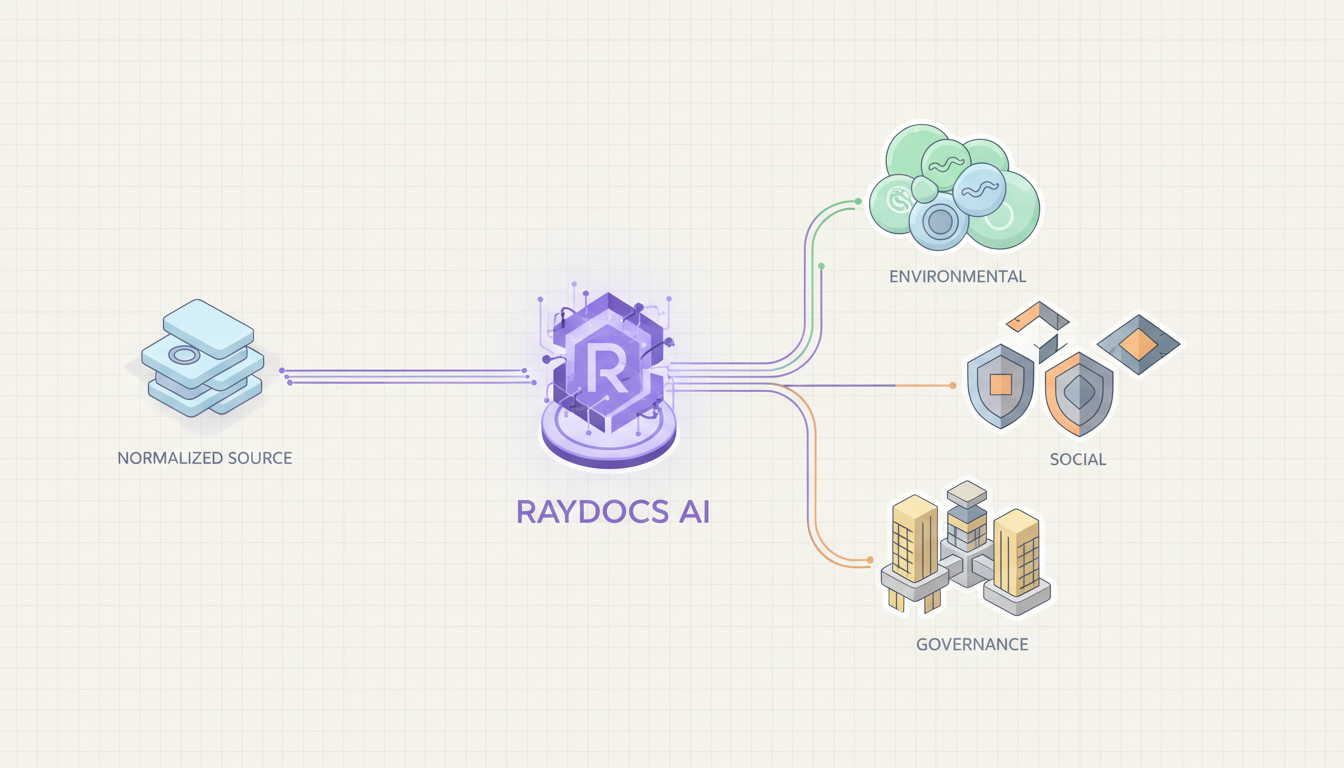
ESG teams rarely work on one isolated theme. They need a common model that can cover several data families:
- environmental: emissions, energy, water, waste, taxonomy, eco-designed products
- social: workforce, diversity, safety, engagement, training
- governance: board composition, independence, remuneration, anti-corruption, due diligence
With Raydocs, these fields can be defined in one schema and extracted consistently across many reports.
That avoids rebuilding a one-off extraction logic for each company or reporting cycle.
An API to industrialize ESG data collection
Useful ESG extraction should not stay trapped in a manual interface.
Raydocs exposes an API that lets you:
- create and version your extraction schemas
- launch extraction sessions on one document or in batches
- retrieve structured results programmatically
- connect extraction into a broader collection, review, or consolidation workflow
That matters when you need to process not five reports, but fifty, one hundred, or one thousand over the course of a reporting cycle.
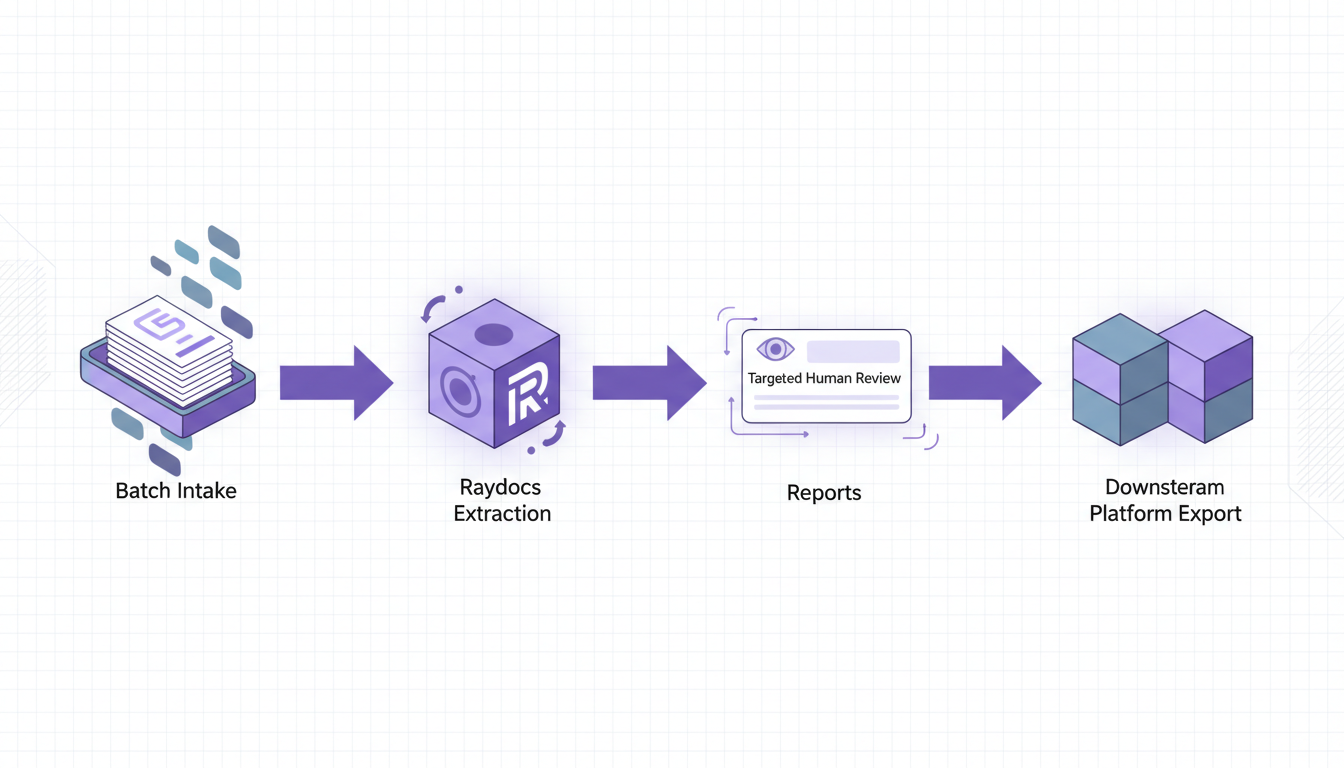
Instead of running extraction file by file, you can connect Raydocs into a larger chain:
- receive reports from issuers or portfolio companies
- trigger ESG extractions automatically
- route only ambiguous cases to human review
- push structured results by API into your ESG platform, internal data stack, or reporting workflow
The critical point: source citation for every value
ESG extraction without source evidence quickly creates a new trust problem.
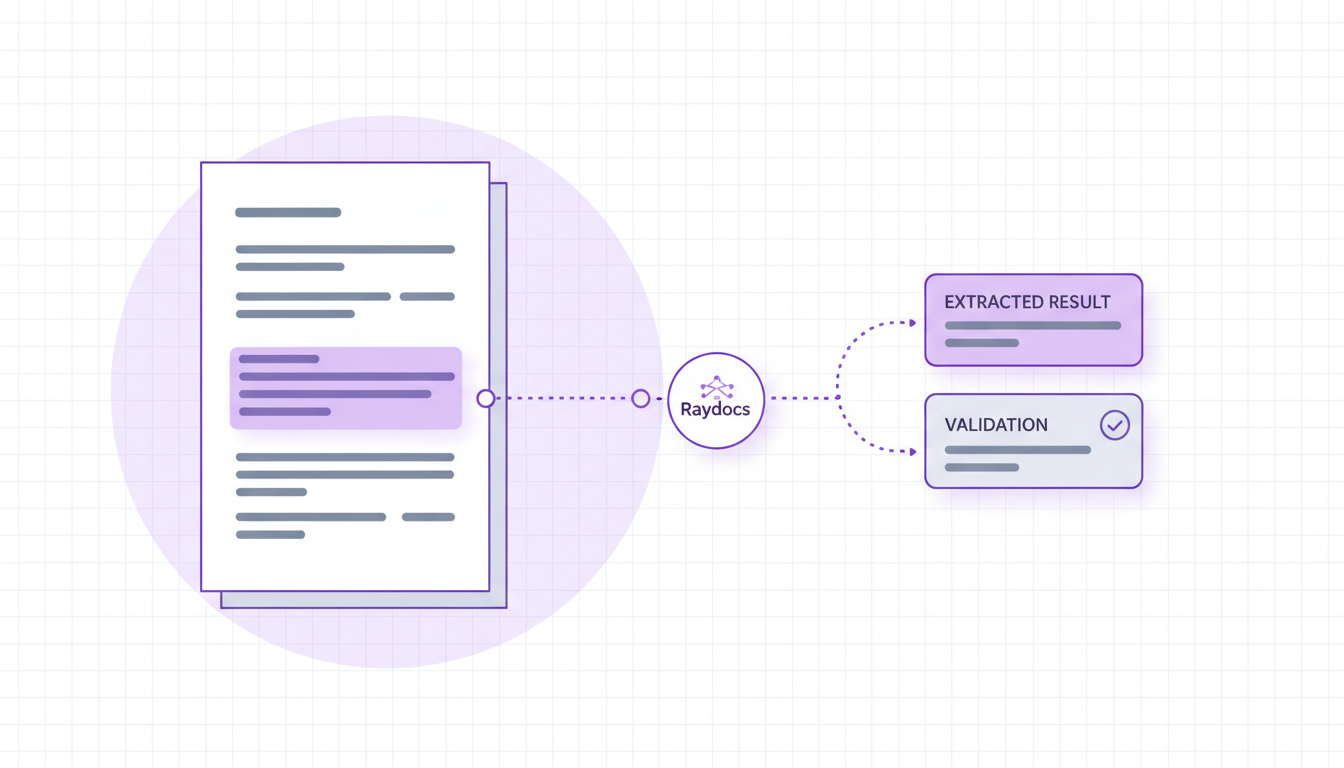
When an analyst or compliance team sees 79.9 for a taxonomy metric, they need to answer three questions immediately:
- which document contained that value?
- which page or table did it come from?
- does the surrounding context confirm the interpretation?
Raydocs links each structured result back to its documentary source. That traceability is essential when you need to:
- accelerate human review
- correct ambiguity quickly
- preserve an audit trail
- reuse the results in a regulatory or investment workflow
Where classic ESG workflows break down
Manual or semi-manual approaches deteriorate quickly when:
- several reports must be compared in parallel
- documents mix narrative text, tables, and annexes
- methodologies change from one year to the next
- some metrics are stated in prose while others only appear in tables
- hundreds of fields must be consolidated on a short timeline
The cost is not only time. It is also the risk of error, duplication, wrong attribution, and lost context.
Built for batch operations and production workflows
ESG extraction becomes truly useful when it runs in a repeatable production setup:
- quarterly or annual disclosure cycles
- portfolio company report collection
- multi-target due diligence
- continuous refresh of an internal ESG database
Raydocs is suited to these scenarios because extraction can run at scale and then be consumed by API in downstream systems. That lets you automate the high-volume layer while keeping human review on the most sensitive outputs.
A concrete example of the target output structure
On a batch of ESG reports, a useful extraction model may include fields such as:
gross_scope_1_ghg_emissionsgross_scope_2_ghg_emissionscapex_eligible_for_eu_taxonomyhas_circular_economy_policytotal_employeeswomen_share_in_workforcepercentage_of_women_on_boardpercentage_of_independent_directorshas_anti_corruption_policy
Each field is more than a filled spreadsheet cell. It can also carry the context needed to understand how the value was found and whether it needs human review.
Raydocs for ESG, compliance, and investment teams
This type of workflow is especially useful if you need to:
- prepare CSRD or extra-financial reporting
- compare multiple issuers or portfolio companies
- feed an internal ESG analysis model
- industrialize governance document review
- replace an Excel-heavy data collection process with something more reliable
Raydocs does not replace your methodology. It accelerates collection, structures the outputs, and keeps documentary proof attached to every extraction.
A practical workflow with Raydocs
A typical setup looks like this:
- You upload one or more annual reports, sustainability reports, or governance documents.
- You define the ESG schema you want to extract.
- Raydocs analyzes the documents and looks for the requested metrics.
- Extracted values are normalized and grouped by field.
- Each result keeps its source citations.
- A human review step validates or corrects ambiguous cases.
- Results are exported or fetched by API.
- A downstream workflow updates reporting, controls, or your ESG platform.
This approach works for one-off projects as well as recurring high-volume workflows.
Raydocs for AI ESG data extraction
If your team wants to move from manual report reading to a structured ESG pipeline, Raydocs can be configured to:
- extract ESG indicators across multiple document types
- read text, tables, and annexes in one flow
- normalize outputs against your schema
- tie every value back to its source
- run batches and fetch the outputs by API
- plug extraction into wider operational workflows
- accelerate review and downstream export
The goal is not only to automate reading. It is to make ESG extraction reliable and traceable enough to reuse in production.